
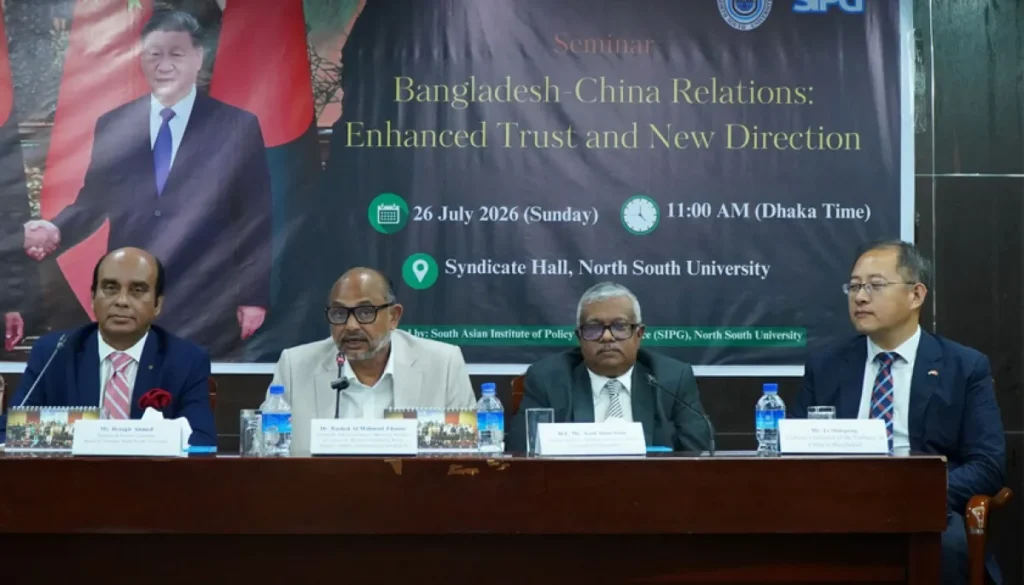
Prime Minister’s Economic Adviser Dr Rashed Al Mahmud Titumir today said the government is pursuing an inclusive foreign policy, engaging constructively with all neighbouring countries while keeping Bangladesh’s national interests at its core.
“Our foreign policy is inclusive, not exclusive,” he said while addressing a discussion titled “Bangladesh-China Relations: Enhanced Trust and New Direction” as the chief guest at North South University (NSU) here.
The South Asian Institute of Policy and Governance (SIPG) of NSU organised the seminar, bringing together policymakers, diplomats, scholars, China experts, media representatives, faculty members and students.
Titumir said the government’s approach marked a departure from what he described as the “exclusive” foreign policy pursued by the previous deposed Sheikh Hasina administration.
Referring to Prime Minister Tarique Rahman’s recent diplomatic engagements, including his visits to Malaysia and China, the adviser said Bangladesh’s diplomacy seeks constructive relations with all partners rather than favouring any particular country or bloc.
“The Prime Minister’s visit to China should not be viewed in isolation,” he said adding “As he visited China, he will also visit our neighbouring countries.”
Titumir underscored the government’s commitment to balanced and inclusive diplomacy.
Referring to the principle of “Shobar Agey Bangladesh”, he said partnerships are most meaningful when they reinforce national priorities, placing Bangladesh’s development, economic sovereignty and people’s welfare at the centre of every collaboration.
He said Bangladesh must pursue its own self-reliant development journey while engaging China on the basis of mutual respect, national interest and economic sovereignty.
Titumir said Bangladesh’s relationship with China has entered a new phase of deeper strategic cooperation following Prime Minister Tarique Rahman’s visit to Beijing in June 2026, with the two countries committed to building a “shared future” based on mutual trust and common prosperity.
“Our friendship is rooted in mutual respect, sovereign equality, non-interference, and a shared aspiration for peace, stability and development,” he said, describing China as a longstanding trusted friend and valued strategic partner of Bangladesh.
Reaffirming Dhaka’s foreign policy position, Titumir said Bangladesh remains firmly committed to the one-China principle and UN General Assembly Resolution 2758, describing them as integral to international law and respect for the sovereignty and territorial integrity of states.
Highlighting the significance of the Prime Minister’s June visit to China, he said the two countries elevated their Comprehensive Strategic Cooperative Partnership to “China-Bangladesh Community with a Shared Future in the New Era”.
The adviser also paid tribute to the leaders who laid the foundation of bilateral ties between Dhaka and Beijing, recalling the visits of former president Shaheed Ziaur Rahman to China in 1977 and 1980, which he said opened the door to modern Bangladesh-China relations.
He also referred to subsequent engagements by former Prime Minister Khaleda Zia that expanded bilateral cooperation across multiple sectors.
Titumir said Bangladesh’s foreign policy under Prime Minister Tarique Rahman remains independent and sovereign, with national interest at its core, while promoting neighbourhood diplomacy, South-South cooperation and constructive engagement with all partners.
“Within this vision, China occupies a place of special importance,” he said.
The adviser welcomed Chinese partnerships in multimodal transportation, the Chinese Economic Zone in Chattogram, expansion of Mongla Port and the proposed Kunming-Chattogram connection, while stressing the need for deeper society-to-society and cultural exchanges.
He said the next challenge for Dhaka and Beijing is to translate their shared vision into tangible outcomes that directly benefit the peoples of the two countries.
Titumir welcomed progress under China’s Global Development Initiative and said Bangladesh is open to expanding practical cooperation wherever the interests of the two countries converge and such collaboration contributes to sustainable development and regional stability.
He said Bangladesh and China are also working to operationalise the proposed 2+2 Dialogue on Diplomacy and Defence and preparing to hold the inaugural foreign minister-level Strategic Dialogue.
The mechanisms, he said, would provide strategic direction to the expanding bilateral partnership.
Turning to economic cooperation, Titumir said Bangladesh’s newly approved Five-Year Strategic Framework for Reform and Development aligns well with China’s upcoming 15th Five-Year Plan, opening further avenues for collaboration.
He said the convergence of the two countries’ development strategies, together with the global 2030 development agenda, provides a strong foundation for pragmatic and mutually beneficial cooperation.
Foreign Secretary Asad Alam Siam, speaking at the seminar, highlighted the positive trajectory of Bangladesh-China relations and referred to recent milestones encompassing agreements, protocols and media cooperation, alongside collaboration in agriculture, water security, supply chains, technology and multilateral forums.
He stressed that the key task ahead is to translate commitments and investments into high-impact projects backed by strong institutional accountability and aligned with Bangladesh’s national interests.
Representing the Chinese Embassy in Bangladesh, Cultural Counsellor Li Shaopeng described the Prime Minister’s visit to China as the beginning of a new chapter in bilateral relations.
“People matter more than infrastructure. Long-term people-to-people bonds matter more than physical connectivity,” he said.
Li highlighted political mutual trust, international coordination and shared development as key foundations of Bangladesh-China cooperation, while stressing greater cooperation in vocational education, Chinese language learning and cultural exchanges.
Ambassador Mohammad Sufiur Rahman, Senior Research Fellow at SIPG, presented the keynote paper, arguing that Bangladesh should move beyond a narrow project-based approach to relations with China and focus on long-term strategic planning.
He said sustainable cooperation should not depend solely on short-term monetary interests, but should place geoeconomics, health, education, research, technology, connectivity and mutual security at the centre of future engagement.
Dr Liu Zongyi, Senior Research Fellow and Director of the Center for South Asia Studies at the Shanghai Institutes for International Studies (SIIS), China, joined the seminar as lead discussant.
Speakers observed that Bangladesh-China relations have moved beyond conventional development cooperation into a broader strategic phase, making it increasingly important to translate diplomatic understandings into visible outcomes while safeguarding Bangladesh’s national interests, economic sovereignty and strategic autonomy.
NSU Board of Trustees member Benjir Ahmed said Bangladesh-China relations should extend beyond business and infrastructure to encompass higher education, research, agriculture, technology, student exchanges and broader human connections.
NSU Vice-Chancellor Professor Abdul Hannan Chowdhury, in his closing remarks, highlighted the evolving diplomatic relationship between China and South Asia and stressed the need for Bangladesh to diversify and expand its export basket to the Chinese market.
The seminar also discussed the proposed Bangladesh-China-Myanmar connectivity framework, BCM+I, Teesta and northern river management, the Rohingya crisis, instability in Myanmar, Bay of Bengal geopolitics and Indo-Pacific competition.
Speakers particularly stressed the importance of avoiding overdependence on any single partner and said Bangladesh should remain open to cooperation with all countries on mutually beneficial terms while carefully navigating the rapidly changing regional and global environment.
SIPG Director Professor Sk. Tawfique M. Haque moderated the seminar and delivered the opening remarks, while Dr S. M. Rubyat, Coordinator of CSCSS and Assistant Professor at NSU, delivered the vote of thanks.
Source: BSS