Lifestyle
The struggles and challenges of clubs outside Dhaka
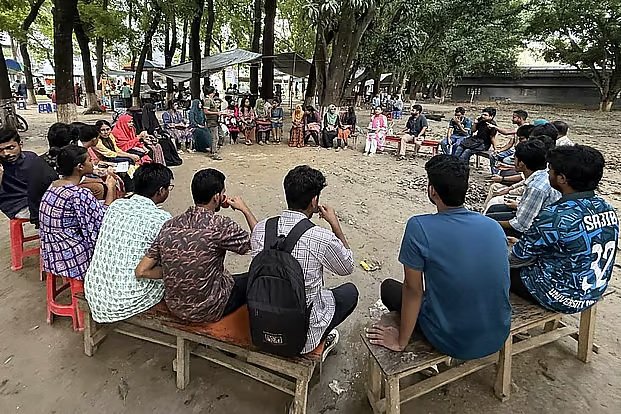
Those who are associated with various clubs or organisations at universities face various challenges, especially financial crisis to implement good ideas.
Spending days and nights on campus, organising programmes while neglecting their meals, returning home, body racked with fatigue and heart full of confidence—that’s normal!
Reality can sometimes be quite complex, especially for universities outside Dhaka.
Despite all good intentions, many events may not materialise as planned. Brilliant ideas often falter simply due to a lack of sponsorship.
For clubs outside Dhaka, organising major events often equates to facing an overwhelming test. Securing sponsors or patrons is quite challenging. It becomes a norm to cut costs, reduce the scale of events, and personally fund part of the budget.
Small budget, big dreams
No matter how big the dream of organising an event on campus, it eventually has to be grounded in reality.
Zeba Anika Chowdhury, General Secretary of the Rajshahi University Education Club, shared their experience: “Often we sit with ideas, and then we start calculating. For us, financial management is the biggest challenge before implementing any idea. Many great ideas have to be downsised just due to budget constraints.”
This reality is not unique to a single club. Clubs in Khulna, Barishal, Cumilla, Jashore, Dinajpur, or Rangpur all have to shape their plans within limited resources. Often, instead of organising multiple programmes together, they have to do them separately. Sometimes, the number of guests needs to be reduced, or the entire event has to be scaled down.
Yet, their dreams are not stopped by these constraints. As Zeba mentioned, “Last year, we organised an international research conference for the first time. Hosting an event of international standard is quite challenging for any club, and without a sponsor, it gets even tougher. For us, being a club outside Dhaka, this event was the most challenging. Even without sponsorship from any major corporate entities, we overcame the challenge with the help of teachers and participation fees. 1,300 people participated in our event from across the country and abroad.”
Funding from their pockets
Due to a lack of funds, club members often fund events from their own pockets. This involves a sense of responsibility and passion. Iftiar Rahman, President of the Robotics Society of Jashore University of Science and Technology, said, “Since taking on the role of president, I’ve noticed that almost every event requires some personal spending. Other members also contribute in this way. Universities in Dhaka, where a single robotics event attracts sponsors, allows for large prize pools, and charges over Tk 2,000 as registration fees, while we have to keep the prize pool small. Sometimes, it’s hard to even set a Tk 500 registration fee, and the expected number of participants isn’t obtained.”
Due to these limitations, club leaders employ various strategies to successfully conduct events. I spoke with Mahmudul Islam from Hajee Mohammad Danesh Science and Technology University. He is the Chairperson of the international organisation IEEE HSTU Student Branch.
He provided an example of implementing programmes by reducing the budget: “We don’t view limited resources merely as constraints; rather, we see them as a creative challenge. Our student branch tries to minimise costs by maximising the use of the campus’ own labs, classrooms, and existing facilities. Additionally, we reduce external expenses by incorporating skilled seniors, alumni, and team members as trainers. In many cases, we can engage more students by using online or hybrid methods. Planned management, teamwork, and optimal use of resources are our primary strategies. Recently, we organised the ”BotBuilder Bootcamp: Semi-Autonomous Soccer Bot Workshop” successfully without any major sponsorship.”
Seeking solutions
In conversations with university-based organisations across the country, it was evident that despite various limitations, they all share one common trait—they are highly initiative-driven. No one is the type to give up. They are committed to showcasing something every semester by coordinating in some way; however, merely strong will isn’t enough to maintain this continuity. Structural support and equal opportunities are essential.
Shubhra Debnath, President of the IT Society of Barishal University, believes the core issue lies in the Dhaka-centricity of the country’s corporate and institutional structures.
He says, “As most companies and business establishments in our country are Dhaka-centric, they mainly collaborate with Dhaka clubs. Even banks and NGOs tend to find Dhaka-centric promotions more effective.”
Shubhra suggests that addressing this disparity requires more than just the clubs’ efforts; a change in the perspective of sponsors and institutions is necessary.
He states, “Rather than considering Dhaka as the sole centre, communication and engagement should be increased in regional zones as well. We want opportunities for skill development to spread across the country for students; however, without corporate support, such initiatives can never have a large-scale impact. I believe, for a sustainable change, a collective effort is needed; where clubs, alumni, corporate institutions, and policymakers work together. Then, hopefully, the situation will improve.”

Lifestyle
PM asks women MPs to prepare for effective role in JS
Temporibus autem quibusdam et aut officiis debitis aut rerum necessitatibus saepe eveniet ut et voluptates repudiandae.
Prime Minister Tarique Rahman has asked BNP lawmakers from women reserved seats to prepare themselves to play an effective role in the Jatiya Sangsad (JS).
The premier gave the directive at a meeting with the women MPs at Cabinet Division at the secretariat here today, according to PM’s press wing.
Tarique Rahman urged the MPs to develop themselves as competent lawmakers by having a clear understanding of the Rules of Procedure of the JS.
He asked the lawmakers to remain cautious and responsible while delivering speeches in the parliament.
The prime minister further directed the MPs to stay vigilant so that no one can mislead the public through misinterpretation of religion. He also emphasized increasing engagement with people in their respective constituencies.
Tarique Rahman said the people had suffered from a kind of mental distress for 17 years and were unable to speak freely.
He added that after the BNP government came to power, people are now enjoying all kinds of democratic rights.
During the meeting, the women MPs expressed their views on various issues, including parliamentary procedures, the current political situation, and implementation of the government’s electoral commitments.
All 36 BNP women MPs attended the meeting, and 17 of them spoke.
After the meeting, women MP Arifa Sultana Ruma told BSS that Prime Minister Tarique Rahman has told them of giving training on parliamentary procedures before the beginning of the next session of the Jatiya Sangsad.
She also said the prime minister instructed them to become more closely connected with people in their constituencies and promote the party’s ideals and activities at the grassroots level.
BNP Secretary General and LGRD and Cooperatives Minister Mirza Fakhrul Islam Alamgir, party’s Senior Joint Secretary General and Prime Minister’s Political and Agriculture Adviser Ruhul Kabir Rizvi were present. BNP have 36 seats out of total 50 reserved seats for women in JS.
Lifestyle
Eliminating misconceptions about controlling high blood pressure
Although it may seem unbelievable, nearly half of the people worldwide who suffer from high blood pressure do not know that they have the condition.
In most cases, it produces no obvious symptoms, allowing the disease to remain undetected. Various misconceptions prevalent in society make the problem even more complicated.
Every year, 17 May marks World Hypertension Day. This year’s theme is “Measure your blood pressure accurately, control it, live longer.”
Common misconceptions
● High blood pressure affects only older people: This is incorrect. High blood pressure is now increasing among young people as well. Imbalanced lifestyles, unhealthy eating habits, mental stress, and physical inactivity are major contributing factors.
● An increase in blood pressure with age is normal: This belief is also inaccurate. If the blood pressure of anyone over the age of 18 exceeds the normal level of 120/80 mmHg, it should receive proper medical attention.
● If there are no symptoms, there is no high blood pressure: High blood pressure is known as the “silent killer”. In most cases, it damages the body without causing noticeable symptoms. Therefore, regular blood pressure monitoring is essential.
● Medication can be stopped once blood pressure becomes normal: This is a dangerous practice. Stopping or changing medication without consulting a physician may cause blood pressure to become uncontrolled again.
● People with high blood pressure must avoid eggs, milk, and meat: The main concern is excessive salt and fatty foods. A person with high blood pressure may consume one whole egg per day, one cup of skimmed milk, and chicken in moderation. Even mutton or beef may be eaten once or twice a month in limited quantities. However, salt, processed foods, and fried foods should be reduced as much as possible.
● Roasted salt is safe to consume: Many people believe that avoiding raw salt is sufficient, so they roast salt before eating it or increase the amount of salt used in cooking. However, excessive salt intake remains equally harmful whether the salt is raw or roasted. Too much salt interferes with blood pressure control.
● Tamarind or sour foods lower blood pressure: There is no scientific evidence to support this belief. In fact, consuming such foods with salt may increase blood pressure. It may also cause acidity and discomfort.
Remember, starting or changing medication based on someone else’s advice or personal preference can be risky.
Treatment for high blood pressure varies from person to person, so consulting a physician is essential.
Let us control this silent killer through regular blood pressure monitoring, healthy lifestyles, and appropriate medical treatment.
-
Tech2 weeks agoBangladeshi Researcher Working on AI-Enabled Resilient Power Systems and Sustainable Solar Technologies
-
Lifestyle18 hours agoPM asks women MPs to prepare for effective role in JS
-
News14 hours agoBangladesh to celebrate Eid-ul-Azha on May 28
-
News14 hours agoRAB working to become symbol of public hope, trust: DG
-
News14 hours agoNEC approves Tk 3 lakh crore ADP for FY27
-
News2 days ago‘Youth Employability Summit 2026’ successfully organised by DUCSU and Skill Jobs
-
Business14 hours agoRemittance inflow surges 35.2pc in 1st 17 days of May
-
Lifestyle2 days agoEliminating misconceptions about controlling high blood pressure