
News
NEC approves Tk 3 lakh crore ADP for FY27

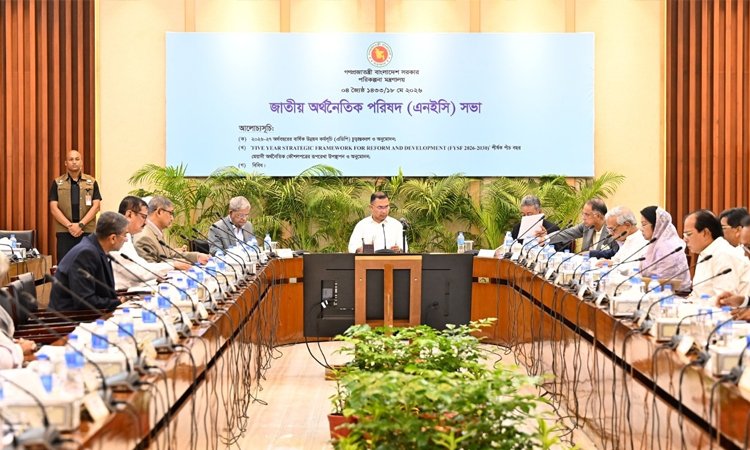
The National Economic Council (NEC) today approved an Annual Development Programme (ADP) outlay worth Taka 3,00,000 crore for the 2026-27 fiscal year aiming to sustain inclusive economic growth, strengthen infrastructures, enhance social protection and accelerate climate-resilient development.
The new ADP for the fiscal year 2026-27 has been designed with a reform-oriented and inclusive development vision aimed at ensuring sustainable economic growth, balanced regional development and administrative modernization.
NEC Chairman and Prime Minister Tarique Rahman presided over the maiden meeting of NEC under the incumbent government held at the NEC Conference Room in the city’s Sher-e-Bangla Nagar area.
After the meeting, Finance and Planning Minister Amir Khosru Mahmud Chowdhury briefed reporters.
Adviser to the Prime Minister on the ministries of Finance and Planning Dr Rashed Al Mahmud Titumir, State Minister for Planning Zonayed Abdur Rahim Saki and Planning Secretary SM Shakil Akhter were present at the briefing.
Ministers, state ministers and secretaries concerned attended the meeting.
The meeting also gave policy approval to a strategic financial planning framework for the next five years, which is being prepared by an advisory committee under the General Economics Division (GED).
According to the Planning Ministry, the approved ADP outlay for FY2026-27 has been estimated around Taka 3,00,000 crore, of which Taka 1,90,000 crore will come from government financing while Taka 1,10,000 crore will be financed through foreign loans and grants.
The size of the ADP is larger than that of the current fiscal year, indicating the government’s growing investment and implementation capacity.
The new ADP also includes a significant number of fresh projects. A total of 1,277 new projects have been recommended by different ministries and divisions, while proposals have been made to include 80 projects under Public-Private Partnership (PPP) and 148 projects under the Bangladesh Climate Change Trust Fund.
The planning ministry said the programme clearly reflects increased emphasis on private sector participation and climate adaptation initiatives.
The ADP has laid special importance on accelerating project implementation and ensuring fiscal discipline. The implementation rate of development expenditure has increased notably in the current fiscal year, signalling improved execution capacity in public investment management.
Among the 15 sectors, the Local Government Division, Road Transport and Highways Division, Health Services Division, and Secondary and Higher Education Division received the highest allocations.
In addition, a special allocation of Taka 17,000 crore has been earmarked for social development assistance programmes aimed at protecting poor and marginalised communities.
A significant number of the newly approved projects are dependent on foreign financing, reflecting the confidence of international development partners in Bangladesh’s development process.
The meeting also directed the authorities concerned to complete projects scheduled for completion by June 2027 on a priority basis, while limiting fresh expenditures under expired projects to make development spending more effective and accountable.
The size of the ADP increased by 50 per cent compared to the revised ADP of the current fiscal year, with a 48.44-per cent rise in domestic resource allocation and a 52.78 per cent increase in external financing.
The fresh ADP prioritises poverty reduction, employment generation, women’s empowerment, regional balanced development, tourism, blue economy, green growth and improvement of people’s living standards through sector-based development interventions.
Planning Commission officials said the overall outlay under the proposed ADP would stand at Tk 3,08,924.83 crore if self-financed projects of autonomous bodies and corporations are included. Of the amount, Tk 1,98,923.93 crore would come from government and own financing sources, while Tk 1,10,000.90 crore would come from foreign loans and grants.
The programme includes 971 investment and survey projects with an allocation of Tk 1,78,914.63 crore and 107 technical assistance projects involving Tk 2,796.28 crore.
In addition, Tk 38,027.49 crore has been proposed under the “special development assistance” block allocation to support newly approved and ongoing projects during the fiscal year. Another Tk 17,000 crore has been earmarked for social development assistance.
The allocation in the new ADP showed that the transport and communication sector received the highest allocation of Tk 50,092.53 crore, accounting for 16.70 percent of the total proposed ADP.
The education sector received Tk 47,591.12 crore or 15.86 percent, while the health sector got Tk 35,535.50 crore, representing 11.84 percent of the total outlay.
The power and energy sector received Tk 32,691.54 crore or 10.90 percent, while the housing and community facilities sector got Tk 20,361.72 crore, accounting for 6.79 percent of the total allocation.
Together, these five sectors accounted for more than 62 percent of the total proposed sectoral allocation.
Among ministries and divisions, the Local Government Division received the highest allocation of Tk 33,735.10 crore or 11.25 percent of the new ADP.
The Roads and Highways Division got Tk 30,741.36 crore or 10.25 percent, while the Health Services Division received Tk 26,806.26 crore.
The Secondary and Higher Education Division got Tk 20,835.44 crore or 6.95 percent, while the Primary and Mass Education Ministry received Tk 19,440.59 crore or 6.48 percent.
The Power Division received Tk 14,938.66 crore or 4.98 percent of the total allocation.
Besides, the Science and Technology Ministry got Tk 17,403.74 crore, the Health Education and Family Welfare Division Tk 8,220.85 crore, the Shipping Ministry Tk 8,206.53 crore and the Water Resources Ministry a significant allocation under the proposed ADP framework.
The Planning Commission has also recommended prioritising projects aligned with the Sustainable Development Goals (SDGs), National Adaptation Plan (NAP), Nationally Determined Contributions (NDC), Green Climate Resilient Development (GCRD) strategy and the Delta Appraisal Framework (DAF).
Priority has also been suggested for projects with confirmed foreign financing, PPP initiatives, climate-resilient infrastructure and regionally balanced development.
According to the Implementation Monitoring and Evaluation Division (IMED), the ADP implementation rate during July 2025 to March 2026 stood at 36.19 percent, with total expenditure amounting to Tk 75,607 crore against the revised allocation of Tk 2,08,936 crore for the current fiscal year.
A total of 26 projects identified for completion in the current fiscal year will be carried over to the next fiscal year.



